Olympics Gender Eligibility: How to Expect in 2026
The End of Waiting: A Final Rule is Coming
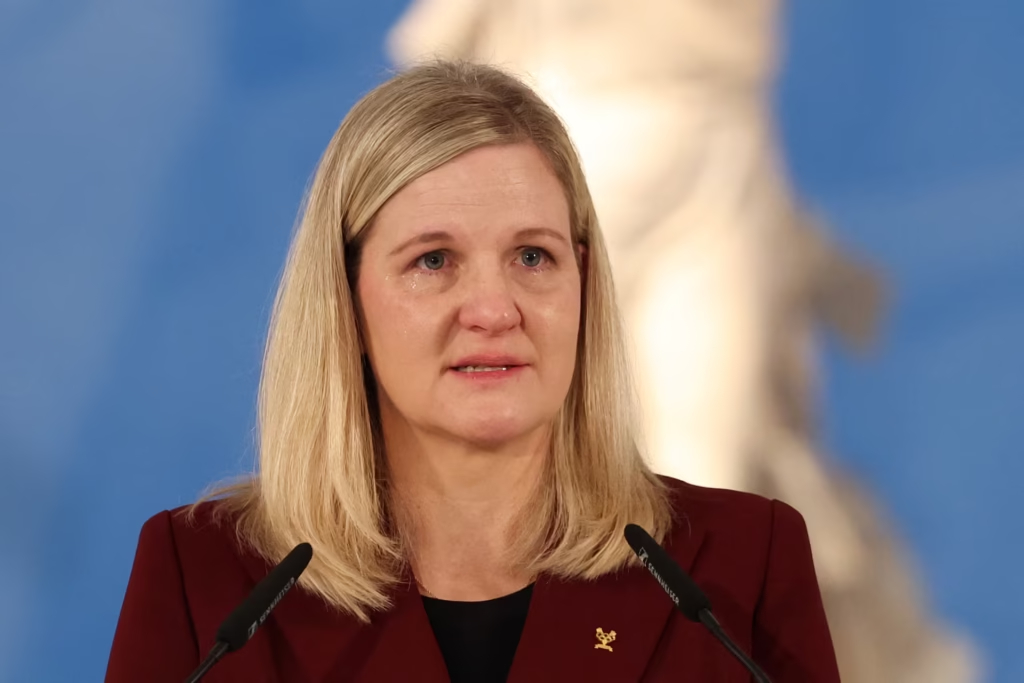
The world of sports is waiting for a very important decision (Olympics Gender). The International Olympic Committee (IOC) has set to announce its final, official rules on gender eligibility. This means they will decide how transgender athletes can compete in the Olympic Games.
The IOC has promised that the new rule would announced in early 2026. This decision is huge. It will set the standard for almost every sport around the world.
The IOC knows this topic is very difficult. It involves big questions about fairness, safety, and inclusion. The final rule must try to balance the rights of all athletes. This is why the IOC has taken so much time.
The Old Rule That Failed Olympics Gender
Before this big delay, the IOC had a simple rule. It has set in 2021. This old rule did away with a main requirement. It said that transgender women no longer had to lower their testosterone levels with medicine.

The Three Problems with the Old Rule
- Too General: The old rule was a framework. It was a guide, not a strict rule. It said that each individual sport should make its own policy. This led to chaos.
- Lack of Consistency: Some sports made strict rules. Others made very open rules. This meant an athlete could compete in one sport but not in another. There was no consistency.
- The Swim Decision: The chaos became clear when the world swimming body, FINA, made a very strict rule. FINA banned all transgender women from women’s swimming events. This decision broke the IOC’s general idea. It showed that the 2021 framework did not work.
The IOC learned from this. They realized they had to create a single, clear rule for the Olympic Games. This is what is coming in 2026.
The Core Conflict: Fairness Versus Inclusion Olympics Gender
The IOC says it has two main values it must balance. These two values are in conflict with each other.
The Side of Fairness
The main argument for strict rules is fairness in competition. This argument focuses on biological advantage.
- Puberty and Bone Density: People who go through male puberty gain a huge physical advantage. This includes larger hearts, larger lungs, and greater bone density. The bodies have built for power and speed.
- Testosterone’s Lasting Effect: Even if a transgender woman lowers her testosterone (the male hormone) levels, the physical advantages do not disappear. The changes in the bone structure and muscle size are permanent.
- Protecting the Women’s Category: Many athletes and groups argue that the women’s category must protected. They say that if biological fairness is not the main rule, women will not be able to win in their own sports anymore. This will harm the idea of women’s sport.
The rule must ensure that a level playing field has kept for all athletes.
The Side of Inclusion
The main argument for open rules is inclusion and the right to compete. This argument focuses on human rights.

- The Right to Belong: Transgender athletes have the right to recognized for their true gender. The IOC’s own principles say that sport should be for everyone, without discrimination.
- Mental Health: Being excluded from sports could cause huge problems for the mental health of transgender athletes. Sport is an important part of life and identity.
- Not All Advantages Are Equal: Some experts say that the physical advantage is not the same in every sport. They say that the advantage in a sport like weightlifting is much bigger than in a sport like shooting or curling. They argue that rules should be made case-by-case for each sport.
The IOC must find a place between these two powerful, conflicting arguments.
The Process: What Took So Long?
The IOC has spent years studying this. They knew they could not make this decision without strong evidence.
- Consulting Scientists: They have held many scientific meetings. They have talked to leading scientists, doctors, and sports researchers. They asked for data on how lowering testosterone affects different sports. They asked about safety risks in high-contact sports like rugby and boxing. Olympics Gender
- Talking to Athletes: They have spoken with hundreds of athletes. This includes cisgender women, transgender women, and transgender men. They listened to their fears, their hopes, and their stories. Olympics Gender
- Ethical Guidance: They also consulted ethicists (people who study morals). The decision is not just scientific. It is about what is morally right for the future of sports. Olympics Gender
This long process shows the complexity. The IOC is trying to create a rule that will last for many years.
What the Final Rule Might Look Like Olympics Gender
The rule that is coming in early 2026 is likely to have a few main parts. It will not be a simple “yes” or “no” answer.
- No Single Rule: The IOC will likely not make a rule that applies to all sports. They will set a very strict, high-level principle. But they will likely still allow individual International Federations (IFs)—like the body that runs track and field—to set their own specific metric. Olympics Gender
- Focus on Puberty: The key focus will be on puberty. The final rule may say that eligibility is based on a “puberty-free” standard. This means an athlete must not have gone through male puberty to compete in the women’s category. This is what the swimming body, FINA, decided. Olympics Gender

- Safety First: For high-contact sports, safety will be the main rule. The IOC is very likely to support rules that ban transgender women from contact sports if they have the muscle mass and bone density of a person who went through male puberty. This protects the safety of the cisgender women they compete against. Olympics Gender
The final rule will be a balance. It will likely prioritize fairness in sports where biological advantage is clear (like racing and lifting) while trying to be as inclusive as possible in other, less power-focused events. Olympics Gender
Olympics Gender Eligibility
The Olympics gender eligibility decision, set for early 2026, will be a defining moment for global sports. The IOC is forced to create a single, clear rule to replace its failed 2021 framework. The decision is being made under intense pressure. It must balance the need for fair competition (which focuses on biological advantage) with the value of inclusion (which focuses on human rights). The final rule is expected to focus heavily on the effects of male puberty and the issue of safety in high-contact sports. The whole world is waiting to see how the IOC will rule on one of the most difficult and emotional issues in sports today. Olympics Gender
Read More Articles Click Here. Read Previous Articles Click Here.


