
What Is Inflation? How It Slowly Destroys Your Savings

Inflation is the reason a cup of chai that cost Rs. 20 a decade ago costs Rs. 80 today. It is one of the most powerful forces in your financial life — and most people never fully understand it. Here is everything you need to know.
Here is a question most people never ask: if you put Rs. 100,000 under your mattress today and left it there for ten years, how much would it be worth when you pulled it out?
The answer is not Rs. 100,000. It is considerably less — because of inflation. That same pile of notes would still physically be Rs. 100,000. But what it could actually buy — the groceries, the petrol, the school fees it could cover — would be significantly less than it could today. Inflation is the invisible force that quietly eats the purchasing power of your money over time.
Understanding inflation is not just academic. It is one of the most practical things you can learn about managing your financial life — because it affects every decision you make about saving, spending, investing and borrowing.
What Is Inflation — The Plain English Version
Inflation is the rate at which the general level of prices for goods and services rises over time. When inflation is happening, the same amount of money buys fewer things than it did before.
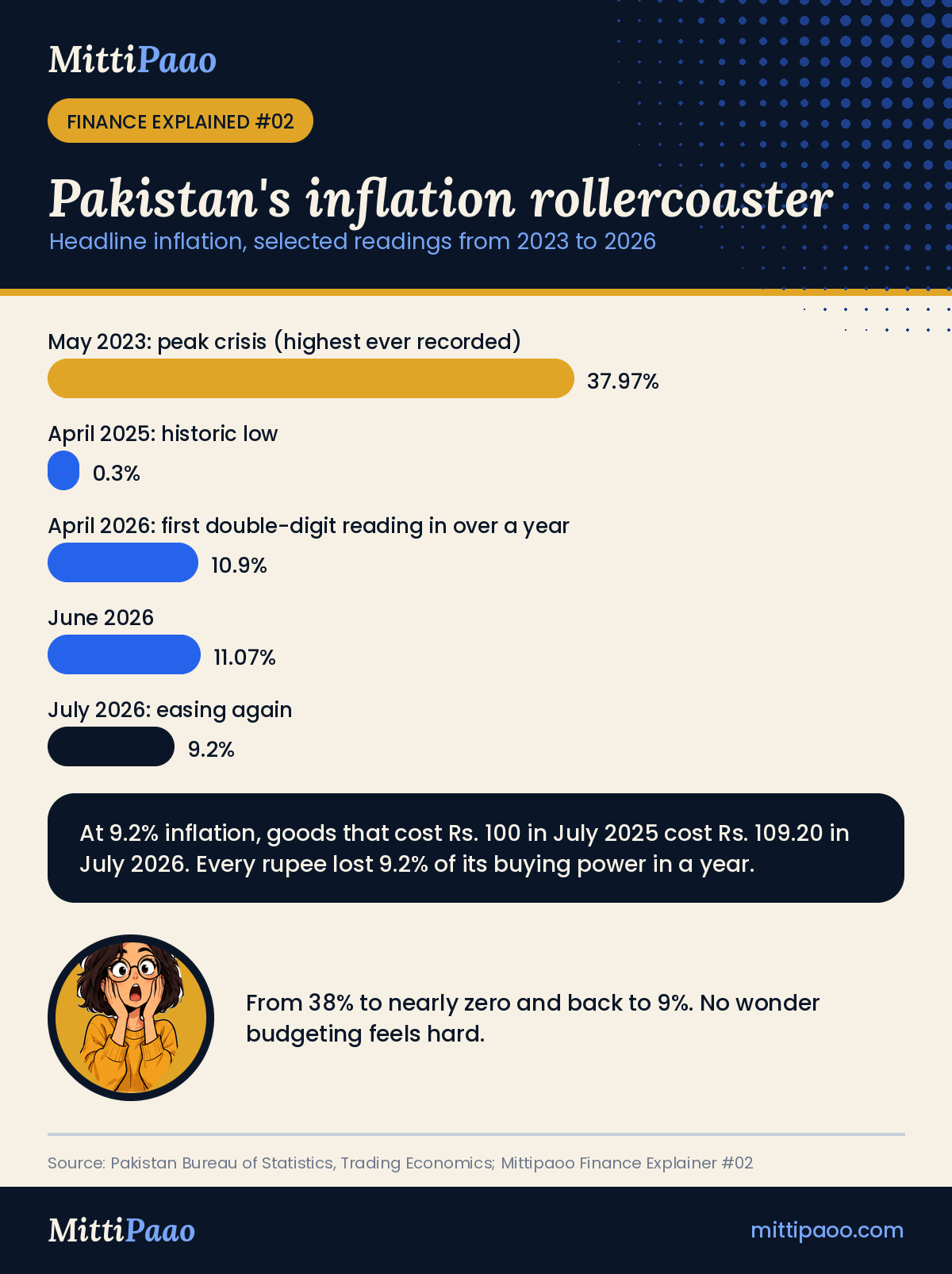
Inflation is typically expressed as a percentage — how much prices have risen over a year. Pakistan’s inflation was 9.2% in July 2026. That means, on average, things that cost Rs. 100 in July 2025 cost Rs. 109.20 in July 2026. Every single rupee in your pocket lost 9.2% of its purchasing power in one year.
How Is Inflation Actually Measured?
Governments measure inflation using something called the Consumer Price Index (CPI). Statisticians compile a “basket” of goods and services that represent what an average household buys — food, rent, transport, utilities, clothing, healthcare, education — and track how the price of that basket changes over time.
Pakistan’s Bureau of Statistics measures three types of inflation indices:
- CPI (Consumer Price Index): Tracks the basket of goods for urban and rural households. This is the headline number you see in news reports. July 2026: 9.2%
- Core Inflation: CPI with food and energy removed — gives a cleaner picture of underlying price pressures. July 2026: approximately 8%
- WPI (Wholesale Price Index): Tracks prices at the wholesale level — often a leading indicator of where CPI is heading. Was 13.6% in April 2026
What Causes Inflation?
Pakistan’s inflation problem is particularly complex because it suffers from all four types simultaneously. In Pakistan, almost every geopolitical conflict reaches Pakistani petrol pumps, electricity bills, transport fares, and kitchen tables. What appears as domestic inflation is, in reality, the local expression of global instability interacting with economic fragility.
How Inflation Destroys Your Savings
This is the most important part. Let us use real numbers.
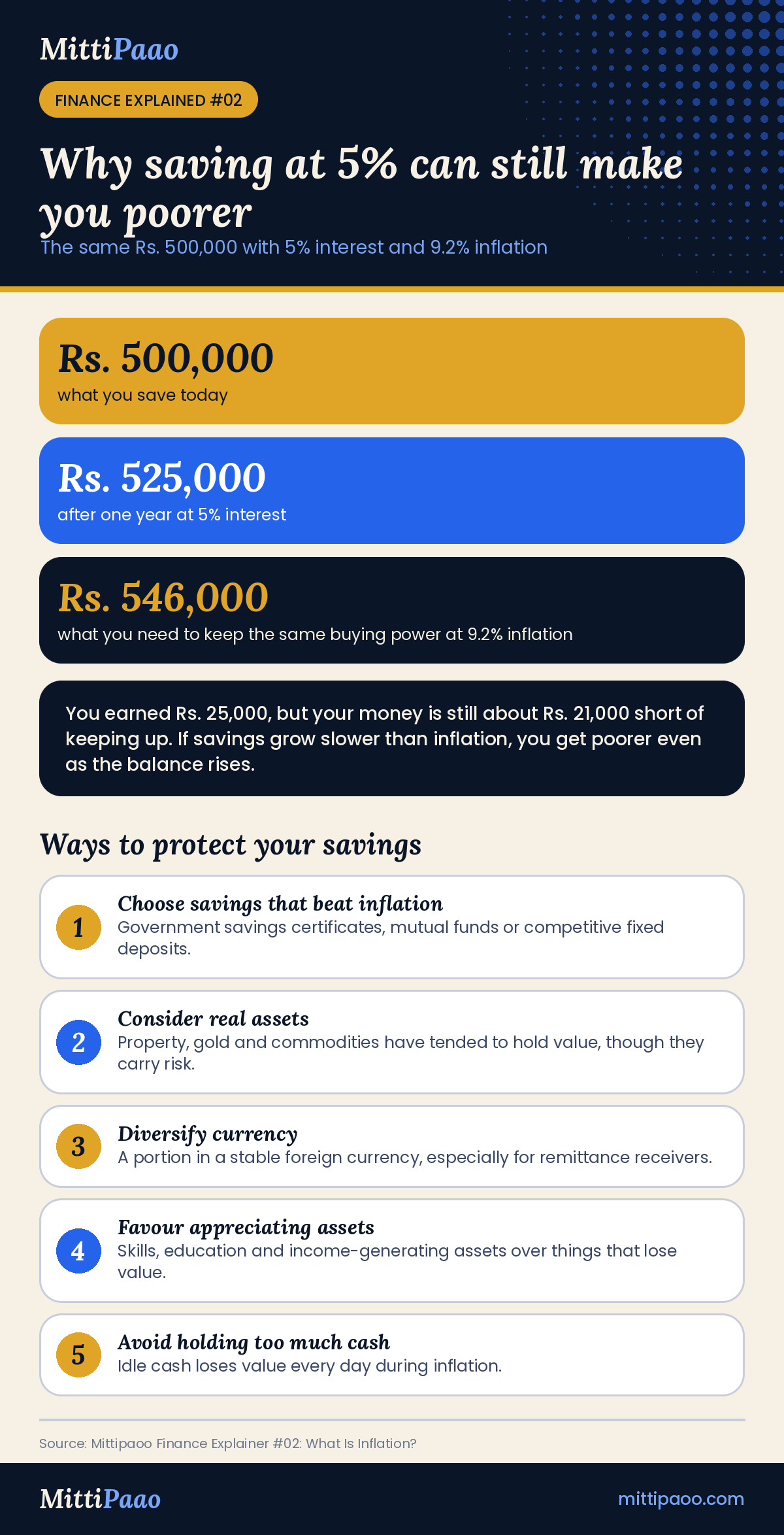
Suppose you put Rs. 500,000 in a standard bank account earning 5% annual interest. After one year, you have Rs. 525,000. That sounds like growth — you earned Rs. 25,000. But if inflation was 9.2% during that same year, the purchasing power of your Rs. 500,000 fell by 9.2%. You needed Rs. 546,000 just to maintain the same purchasing power you had at the start of the year. So despite earning Rs. 25,000 in interest, you actually lost ground. Your real return was negative — approximately minus 4.2%.
If your savings are growing slower than inflation, you are getting poorer — even as the number in your bank account goes up.
This is why simply saving money in a low-interest account is not enough during periods of high inflation. Your money needs to grow faster than inflation or it is being quietly eroded year after year.
Pakistan’s Inflation Story — The Rollercoaster of 2021–2026
🇵🇰 Pakistan’s Inflation Journey — The Numbers
May 2023 — Peak crisis: Pakistan’s inflation rate reached 37.97% — the highest level ever recorded. A devastating blow to household purchasing power, particularly for lower and middle income families.
2025 — Historic recovery: In April 2025, the headline inflation rate hit a historic low of 0.3% — the lowest in Pakistan’s history, primarily due to declining global commodity and energy prices, a stable exchange rate, a high base effect, recovering foreign reserves, and tight monetary policy.
April 2026 — Return of pressure: Pakistan’s headline inflation hit 10.9% in April 2026, the first double-digit reading in more than a year, driven by transport, housing, utilities, and wholesale prices all accelerating at once.
July 2026 — Easing again: Pakistan’s inflation rate for July 2026 was 9.2% year-on-year, down from 11.07% in June 2026. The trend is improving but remains above the State Bank’s target range.
Good Inflation vs Bad Inflation
Not all inflation is bad. In fact, a small, stable level of inflation — typically around 2–3% — is considered healthy for an economy. Here is why: when prices rise slowly and predictably, people are incentivised to spend and invest now rather than wait, which keeps the economy moving. It also gives companies room to raise wages gradually without losing profitability.
The problem comes when inflation becomes too high (destroying purchasing power), too unpredictable (making planning impossible), or too persistent (becoming entrenched in expectations — people expect prices to keep rising, so they demand higher wages, which pushes prices higher still, creating a spiral).
Pakistan’s move from 38% inflation in 2023 to near-zero in early 2025 and back to 9–10% in 2026 illustrates how volatile and difficult to control inflation can be — especially in an emerging economy exposed to global commodity prices and currency fluctuations.
What Can You Do to Protect Yourself?
- Keep savings in instruments that beat inflation: Government savings certificates, mutual funds, or fixed deposits at competitive rates. In 2026, the State Bank’s policy rate is above 10% — look for savings products offering similar or higher returns.
- Invest in real assets: Property, gold and commodities have historically preserved value during high-inflation periods. They are not risk-free, but they tend to hold purchasing power better than cash.
- Diversify your currency exposure: If possible, hold a portion of savings in a stable foreign currency. This is particularly relevant for Pakistanis who receive remittances from abroad.
- Spend on appreciating assets, not depreciating ones: During high inflation, a car (which depreciates) is a poor store of value. Skills, education and income-generating assets are better investments.
- Avoid holding too much cash: Cash in your wallet or a zero-interest current account loses value every day during inflation. Put idle money to work.
Sources: FinHisaab Pakistan Inflation Calculator, Pakistan Bureau of Statistics, Trading Economics, Business Recorder, Assahifa, Wikipedia Pakistan Economic Crisis. Updated November 2026.


